I was born into the Catholic Church.
My teachers promised me heaven.
They quoted ancient texts written by ancient people,
Stories of ancient dreams and fantasies:
when kings had power of life and death,
and women were owned by men.
I joined a Catholic religious order
and discovered that that their whole story is false,
A baseless dream of infallible power.
Now we understand how the world works.
What makes the wind and the rain.
How CO2 heats the atmosphere.
Knowledge gained from practical study of the physical world.
At this moment we taking Earth beyond it limits,
Stressing it toward the point of collapse.
People are starving and homeless, species are dying;
We are taking far too much for ourselves.
War remains pandemic, driven by theocratic genocide,
Baseless dreams of divinely promised land.
How can we fix it?
By facing the physical truth.
We must go back to the beginning:
God is real, our weight. We feel them all the time.
Bare gravitation is the divine foundation of reality.
It has no structure,
but it has an omnipotent lust for life,
limited only by impossibility.
It is identical to the Christian god of Aquinas (1225 -1274).
It is the source of the Universe.
We are divine children of a this divine being.
We feel it every moment of our lives,
Keeping us grounded in Earth.
It shapes everything and creates the world.
By studying our physical world with careful intelligence,
We can learn to live together securely and peacefully,
just like the trillions of individual cells in own bodies,
cooperating for common life.
Fourtee easy steps to a Universe
Prologue: Evolution and science create new reality in body and mind
At present we are faced by a forest of dead ends. Our physics cannot understand gravitation; our theology is a disparate thicket of incompatible mythologies, unable to work together and often at war. Democracy is failing before the violent assault of solipsistic autocrats like Trump, Xi, and Putin, supported by poorly educated and ignorant populations. Many people are experiencing genocide, war, repression, starvation, poverty, homelessness, racial and sexual abuse, uncertainty and insecurity. Hope may be struggling in the face of all this pain.
We need a new beginning, but it cannot be on the Moon or Mars. It must be here. One thing is clear, the Universe of galaxies, stars, and planets is magnificent. The problem is in our own little planet, all our own work. The fundamental problem is political. Many of our politicians would like to help, but do not know what to do.
The first step on the way forward is scientific understanding of how the Universe works; how it built itself, our world and our bodies. How was it done? It evolved, step by step, as Darwin explained, by trial and error. Charles Darwin (1859): The Origin of Species
Science is our mental evolution, bringing our minds into physical contact with the real universe. This divine being has discovered the answers to all our questions over 14 billion years of steady work. We are gradually learning all these answers. Darwin's theory of evolution has completely revised our understanding of ourselves and our world and showed us that everything is as perfect as it can be.
Now we know that the world was not created by an omnipotent and omniscient God is six days. Instead, the Universe evolved from an eternal, omnipotent, structureless and completely ignorant random beginning guided only by the fact that contradictions cannot exist. Here we call this beginning the Aquinas–Einstein symmetry understood as an empty mind leearning to know itself.
The old theological view is that an omnipotent and omnipresent god controls every event in reality right down to the finest detail. Everything is "meant to be” in the mind of this God. This is determinism, the work of Laplace's demon. Aquinas, Summa, I, 22, 3: Does God have immediate providence over everything?, Determinism - Wikipedia, Laplace's demon - Wikipedia
Albert Einstein was a determinist. His God did not play dice. He was on the wrong track. Our deepest theory says that entropy generally increases. Chance is always playing with us. Einstein opposed quantum theory until his dying day because he saw it was incomplete and left many things to chance. The world is incomplete because it embraces the randomness necessary for creativity. A deterministic system cannot be creative. It is doomed to run in the same groove forever. Random events are at the heart of creative evolution.
Many controlling theocrats like the Pope and his tribe believe that they have a mandate from the deterministic creator living in their own imaginations to tell everybody what to do. A lot of these people are proselytizers, trying to promote their ideas. Some are crusaders, practicing conversion by military violence and murdering people who don't fit in. They are the source of the unnecessary war, pain and suffering in the world, often demanding that people sacrifice their lives to their imaginary schemes of conquest. Some offer instant paradise to those killed in their unnecessary battles.
This all wrong. We are not creatures of an omniscient all knowing creator, but inhabitants of a self-creating Universe. Evolution works like art and science. Variation, like imagination, explores the realm of possibility; selection, like scientific experiment, picks out the species and the ideas that are capable of reproducing themselves to overcome death and become durable elements of reality.
How does this idea work? First we do a quick survey. Then, on the following pages, we will expand each of these steps into a detailed essay on creation, bringing physics and theology into harmony with one another.
Finally we will run through the whole story once more, pointing out some of its advantages in terms of human welfare: that is in long life, happiness and peace on Earth. We no longer postulate heaven for the good and hell for the bad but a route to everyone enjoying their lives. We must learn from the nature of the world to restrain our greed and pride to honour the system that created us.
Our model is our own bodies, communities of trillions of independent cells all working to a common plan for their collective welfare.1: In the beginning
1. In the beginning we have naked gravitation, a structureless, eternal, dynamic topological space, an empty set, ∅, continuous, complete and convex. It represents the axioms of probability theory and fixed point theory. It is analogous to the traditional gods but open to all possibilities. Andrei Kolmogorov (1956): Foundations of the Theory of Probability, Brouwer fixed point theorem - Wikipedia
2. Random Hilbert space
Fixed point theory endows naked gravitation with Hilbert space, an abstract mathematical space. Hilbert space is similar to the familiar classical four dimensional space and and time in which we live and move. Although it may have an infinite number of dimensions, Hilbert space is much simpler than classical space. It has no distance or time. It is more like a space of sounds, speech or music, all things that are made of waves. The wave nature of Hilbert space is described by the periodic complex numbers. John von Neumann (2018): The Mathematical Foundations of Quantum Mechanics, Complex number - Wikipedia
Since naked gravitation is structureless is has no symbolic knowledge and so actions of its omnipotence are random. The Hilbert space it creates within itself will be random, providing the random variation necessary for creative evolution. Since it is eternal and omnipotent, it can explore an unlimited set of variations. Since the world exists, it must have ultimately arrived, by trying every possibility, at the structure of the universe that we now inhabit. Variety (cybernetics) - Wikipedia, Aquinas, Summa I, 25, 3: Is God omnipotent?
3. Quantum selected mind space
Quantum mechanics shows how Hilbert space behaves. It began as a physical theory but now we see it as a theory of computation and communication, a theory of mind. We understand quantum theory in its native Hilbert space as a logical operator at least as powerful as a classical Turing machine. Linear operators in Hilbert space select sets of stationary states known as eigenvectors from the variation within naked gravitation. Space and time as understood in physics do not yet exist. The stationary forms produced by quantum mechanics are the operators which control the properties of the independent particles like photons formed when quantum states are endowed with energy. Nielsen & Chuang (2016): Quantum Computation and Quantum Information, Planck constant - Wikipedia, Eigenvalue algorithm - Wikipedia
4: Energy derived from gravitation
We understand that the total energy of the Universe begins and always remains zero. The idea is that the stationary states selected by quantum mechanics induce zero energy naked gravitation to split into kinetic and potential energy. The kinetic energy transforms the stationary states into real dynamic particles, ie substances like electrons, as understood in philosophy. The potential energy establishes potential wells which stabilize the system. This process was first envisaged by Aristotle when he invented hylomorphism to bring Plato's forms down to Earth and differentiate them. Here we replace matter with energy, its equivalent in modern physics. Ousia - Wikipedia, Richard Feynman (2002): Feynman Lectures on Gravitation, pp 9 -10. Zero-energy universe - Wikipedia
5: The selective Natural Intelligence of quantum mechanics
Potentially observable quantum states are represented by vectors in Hilbert space. Quantum events involve linear operators (often represented by matrices) superposing vectors onto one another in Hilbert space. Observable events are mapped by self-adjoint of hermitian operators whose eigenvectors have real stationary eigenvalues, like the frequency of an electronic transition in an atom. The stationary states chosen by quantum theory are in effect solutions to the eigenvalue problems implicit in the variety on offer. Modern laboratory observations show that all the states made observable by energy drawn from gravitation fall into one of two categories, fermions and bosons. Quantum Intelligence identifies the stationary states created by the superposition of random vectors in Hilbert space and so performs the role of natural selection in quantum evolution.
6: Massless messengers
Bosons carry information between fermions encoded as energy (frequency) and phase (spin). The majority of bosons are massless and travel on null geodesics at the speed of light in Minkowski space, where we observe them. The most common bosons are the photons which light up our lives, perhaps the first independent particles formed in the universe. Boson - Wikipedia
7: Massive fermions are sources, communicating by exchanging bosons
By source we understand any entity capable of sending and receiving messages, an elementary particle, a person or a planet. Fermions are massive elementary particles that communicate through bosons: Fermions obey the exclusion principle and require a three dimensional Euclidean space to move freely because no two of them can exist in the same place at once. Fermion - Wikipedia, Pauli exclusion principle - Wikipedia
8. Classical spacetime
The metric of Minkowski space has two features that arise from massless bosons and fermions. The negative time coordinate permits the existence of null geodesics along the path taken by photons as they move through three dimensional Euclidean space at the speed of light. The three positive distance coordinates provides a space in which fermions obeying the exclusion principle can move freely. Minkowski space provides the geometric foundation that converts naked gravitation into Einstein gravitation. Minkowski space - Wikipedia, Einstein (1923): The Principle of Relativity - A collection of original memoirs on the special and general theory of Relativity. Sommerfeld, Einstein, Lorentz, Weyl and Minkowski, Geodesics in general relativity - WikipediaGeodesics in general relativity - Wikipedia
9. Einstein's gravitation
Minkowski space gives structure to the Universe. At the end of his article on the field equation of gravitation Einstein notes that the postulate of general relativity cannot reveal to us anything new and different about the essence of the various processes in nature than what the special theory of relativity taught us already. Albert Einstein (1915): The Field Equations of Gravitation
10: Divinity in spacetime
The computational power of quantum mechanics in Hilbert space accounts for the existence of all the observed fundamental particles and for all their interactions with one another. The properties of these particles enable the construction of complex networks such as ourselves and all the other observable objects in the Universe and ultimately the Universe itself. Black holes occur when the local gravitational potential becomes so intense that the quantum mechanical structure of spacetime is collapsed. Hawking & Ellis (1975): The Large Scale Structure of Space-Time, Big Bang - Wikipedia, Black hole - Wikipedia
[27 October 2026: to be revised and completed]
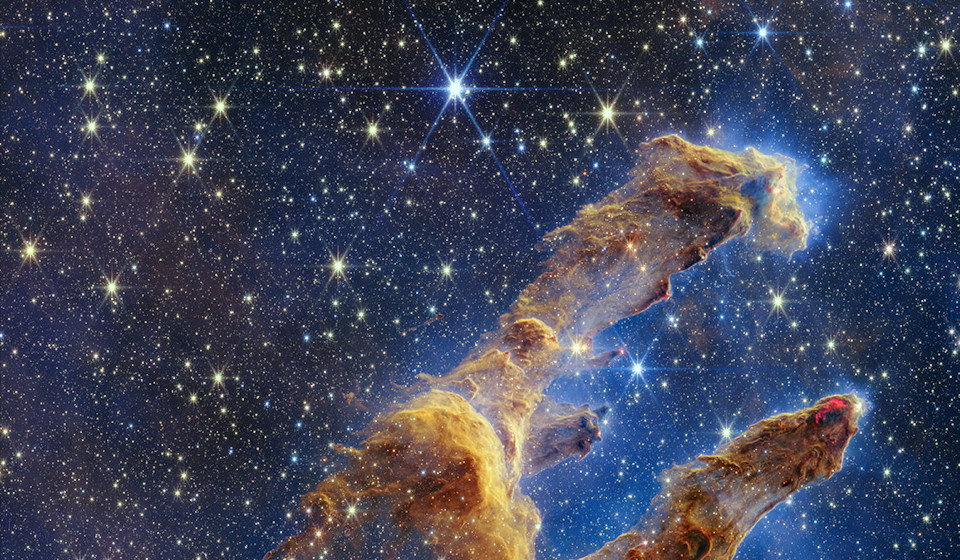
Image: The Pillars of Creation are set off in false colour in NASA’s James Webb Space Telescope’s near-infrared-light view. This image is set within the Eagle Nebula, 6,500 light-years away. This is a region where young stars are forming – or have barely burst from their dusty cocoons as they continue to form. Credits: NASA, ESA, CSA, STScI; Joseph DePasquale (STScI), Anton M. Koekemoer (STScI), Alyssa Pagan (STScI).
Copyright:
You may copy this material freely provided only that you quote fairly and provide a link (or reference) to your source.
Notes and references
Further reading
Books
Darwin (1859), Charles, The Origin of Species: By Means of Natural Selection, or the Preservation of Favoured Races in the Struggle for Life, Cambridge University Press 1859, 2009 ' It's hard to talk about The Origin of Species without making statements that seem overwrought and fulsome. But it's true: this is indeed one of the most important and influential books ever written, and it is one of the very few groundbreaking works of science that is truly readable. . . .
Darwin's friend and "bulldog" T.H. Huxley said upon reading the Origin, "How extremely stupid of me not to have thought of that." Alfred Russel Wallace had thought of the same theory of evolution Darwin did, but it was Darwin who gathered the mass of supporting evidence—on domestic animals and plants, on variability, on sexual selection, on dispersal—that swept most scientists before it.' Mary Ellen Curtin
|
Einstein (1923), Albert, and Einstein, Lorentz, Minkowski, Weyl and Sommerfeld, The Principle of Relativity - A collection of original memoirs on the special and general theory of Relativity. With notes by A. Sommerfeld. Translated by W. Perrett and G. B. Jeffery, Methuen 1923 Minkowski: ' We can determine the ratio of the units of length and time beforehand in such a way that the natural limit of velocity becomes c = 1. If we introduce it = s in place of t the quadratic differential expression dτ2 = - x2 - y2 - z2 - s2 thus becomes perfectly symmetrical in x, y, z, s; and this symmetry is communicated to any law which does not contradict the world postulate. Thus the essence of this postulate may be clothed in a very pregnant manner in the mystic formula 3.105 = i seconds.'
|
Feynman (2002), Richard, Feynman Lectures on Gravitation, Westview Press 2002 ' The Feynman Lectures on Gravitation are based on notes prepared during a course on gravitational physics that Richard Feynman taught at Caltech during the 1962-63 academic year. For several years prior to these lectures, Feynman thought long and hard about the fundamental problems in gravitational physics, yet he published very little. These lectures represent a useful record of his viewpoints and some of his insights into gravity and its application to cosmology, superstars, wormholes, and gravitational waves at that particular time. The lectures also contain a number of fascinating digressions and asides on the foundations of physics and other issues.' [zero-energy universe, pp 9 - 10]
|
Hawking (1975), Steven W, and G F R Ellis, The Large Scale Structure of Space-Time, Cambridge UP 1975 Preface: Einstein's General Theory of Relativity . . . leads to two remarkable predictions about the universe: first that the final fate of massive stars is to collapse behind an event horizon to form a 'black hole' which will contain a singularity; and secondly that there is a singularity in our past which constitutes, in some sense, a beginning to our universe. Our discussion is principally aimed at developing these two results.'
|
Kolmogorov (1956), Andrey Nikolaevich, and Nathan Morrison (Translator) (With an added bibliography by A T Bharucha-Reid), Foundations of the Theory of Probability, Chelsea 1956 Preface: 'The purpose of this monograph is to give an axiomatic foundation for the theory of probability. . . . This task would have been a rather hopeless one before the introduction of Lebesgue's theories of measure and integration. However, after Lebesgue's publication of his investigations, the analogies between measure of a set and mathematical expectation of a random variable became apparent. These analogies allowed of further extensions; thus, for example, various properties of independent random variables were seen to be in complete analogy with the corresponding properties of orthogonal functions . . .'
|
Nielsen (2016), Michael A., and Isaac L Chuang, Quantum Computation and Quantum Information, Cambridge University Press 2016 Review: A rigorous, comprehensive text on quantum information is timely. The study of quantum information and computation represents a particularly direct route to understanding quantum mechanics. Unlike the traditional route to quantum mechanics via Schroedinger's equation and the hydrogen atom, the study of quantum information requires no calculus, merely a knowledge of complex numbers and matrix multiplication. In addition, quantum information processing gives direct access to the traditionally advanced topics of measurement of quantum systems and decoherence.' Seth Lloyd, Department of Quantum Mechanical Engineering, MIT, Nature 6876: vol 416 page 19, 7 March 2002.
|
von Neumann (2018), John, and Nicholas A. Wheeler (editor), Robert T Beyer (translator), The Mathematical Foundations of Quantum Mechanics, Princeton University Press 2018 ' Quantum mechanics was still in its infancy in 1932 when the young John von Neumann, who would go on to become one of the greatest mathematicians of the twentieth century, published Mathematical Foundations of Quantum Mechanics--a revolutionary book that for the first time provided a rigorous mathematical framework for the new science. Robert Beyer's 1955 English translation, which von Neumann reviewed and approved, is cited more frequently today than ever before. But its many treasures and insights were too often obscured by the limitations of the way the text and equations were set on the page. In this new edition of this classic work, mathematical physicist Nicholas Wheeler has completely reset the book in TeX, making the text and equations far easier to read. He has also corrected a handful of typographic errors, revised some sentences for clarity and readability, provided an index for the first time, and added prefatory remarks drawn from the writings of Léon Van Hove and Freeman Dyson. The result brings new life to an essential work in theoretical physics and mathematics.'
|
Links
Albert Einstein (1915), The Field Equations of Gravitation, ' In two recently published papers I have shown how to obtain field equations of gravitation that comply with the postulate of general relativity, i.e., which in their general formulation are covariant under arbitrary substitutions of space-time variables. [. . .] With this, we have finally completed the general theory of relativity as a logical structure. The postulate of relativity in its most general formulation (which makes space-time coordinates into physically meaningless parameters) leads with compelling necessity to a very specific theory of gravitation that also explains the movement of the perihelion of Mercury. However, the postulate of general relativity cannot reveal to us anything new and different about the essence of the various processes in nature than what the special theory of relativity taught us already. The opinions I recently voiced here in this regard have been in error. Every physical theory that complies with the special theory of relativity can, by means of the absolute differential calculus, be integrated into the system of general relativity theory — without the latter providing any criteria about the admissibility of such physical theory' back |
Aquinas, Summa, I, 10, 2, Is God eternal?, 'I answer that, The idea of eternity follows immutability, as the idea of time follows movement, as appears from the preceding article. Hence, as God is supremely immutable, it supremely belongs to Him to be eternal. Nor is He eternal only; but He is His own eternity; whereas, no other being is its own duration, as no other is its own being. Now God is His own uniform being; and hence as He is His own essence, so He is His own eternity.' back |
Aquinas, Summa I, 25, 3, Is God omnipotent?, '. . . God is called omnipotent because He can do all things that are possible absolutely; which is the second way of saying a thing is possible. For a thing is said to be possible or impossible absolutely, according to the relation in which the very terms stand to one another, possible if the predicate is not incompatible with the subject, as that Socrates sits; and absolutely impossible when the predicate is altogether incompatible with the subject, as, for instance, that a man is a donkey.' back |
Aquinas, Summa, I, 22, 3, Does God have immediate providence over everything?, ' I answer that, Two things belong to providence—namely, the type of the order of things foreordained towards an end; and the execution of this order, which is called government. As regards the first of these, God has immediate providence over everything, because He has in His intellect the types of everything, even the smallest; and whatsoever causes He assigns to certain effects, He gives them the power to produce those effects. Whence it must be that He has beforehand the type of those effects in His mind. As to the second, there are certain intermediaries of God's providence; for He governs things inferior by superior, not on account of any defect in His power, but by reason of the abundance of His goodness; so that the dignity of causality is imparted even to creatures.' back |
Aquinas, Summa, I, 3, 7, Is God altogether simple?, 'I answer that, The absolute simplicity of God may be shown in many ways. First, from the previous articles of this question. For there is neither composition of quantitative parts in God, since He is not a body; nor composition of matter and form; nor does His nature differ from His "suppositum"; nor His essence from His existence; neither is there in Him composition of genus and difference, nor of subject and accident. Therefore, it is clear that God is nowise composite, but is altogether simple. . . . ' back |
Aquinas, Summa: I, 2, 3, Does God exist?, 'I answer that, The existence of God can be proved in five ways. The first and more manifest way is the argument from motion. . . . ' back |
Big Bang - Wikipedia, Big Bang - Wikipedia, the free encyclopedia, ' The Big Bang theory is the prevailing cosmological model explaining the existence of the observable universe from the earliest known periods through its subsequent large-scale evolution. The model describes how the universe expanded from an initial state of high density and temperature, and offers a comprehensive explanation for a broad range of observed phenomena, including the abundance of light elements, the cosmic microwave background (CMB) radiation, and large-scale structure. ' back |
Black hole - Wikipedia, Black hole - Wikipedia, the free encyclopedia, ' A black hole is a region of spacetime where gravity is so strong that nothing, including light and other electromagnetic waves, has enough energy to escape it. The theory of general relativity predicts that a sufficiently compact mass can deform spacetime to form a black hole. The boundary of no escape is called the event horizon. Although it has a great effect on the fate and circumstances of an object crossing it, it has no locally detectable features according to general relativity. In many ways, a black hole acts like an ideal black body, as it reflects no light. Moreover, quantum field theory in curved spacetime predicts that event horizons emit Hawking radiation, with the same spectrum as a black body of a temperature inversely proportional to its mass. This temperature is of the order of billionths of a kelvin for stellar black holes, making it essentially impossible to observe directly. ' back |
Black hole thermodynamics - Wikipedia, Black hole thermodynamics - Wikipedia, the free encyclopedia, 'In physics, black hole thermodynamics is the area of study that seeks to reconcile the laws of thermodynamics with the existence of black hole event horizons. Much as the study of the statistical mechanics of black body radiation led to the advent of the theory of quantum mechanics, the effort to understand the statistical mechanics of black holes has had a deep impact upon the understanding of quantum gravity, leading to the formulation of the holographic principle.' back |
Boson - Wikipedia, Boson - Wikipedia, the free encyclopedia, 'In particle physics, bosons are particles with an integer spin, as opposed to fermions which have half-integer spin. From a behaviour point of view, fermions are particles that obey the Fermi-Dirac statistics while bosons are particles that obey the Bose-Einstein statistics. They may be either elementary, like the photon, or composite, as mesons. All force carrier particles are bosons. They are named after Satyendra Nath Bose. In contrast to fermions, several bosons can occupy the same quantum state. Thus, bosons with the same energy can occupy the same place in space.' back |
Brouwer fixed point theorem - Wikipedia, Brouwer fixed point theorem - Wikipedia, the free encyclopedia, 'Among hundreds of fixed-point theorems] Brouwer's is particularly well known, due in part to its use across numerous fields of mathematics. In its original field, this result is one of the key theorems characterizing the topology of Euclidean spaces, along with the Jordan curve theorem, the hairy ball theorem, the invariance of dimension and the Borsuk–Ulam theorem. This gives it a place among the fundamental theorems of topology.' back |
Complex number - Wikipedia, Complex number - Wikipedia, the free encyclopedia, 'A complex number is a number that can be expressed in the form a + bi, where a. and b are real numbers and |
Determinism - Wikipedia, Determinism - Wikipedia, the free encyclopedia, ' Determinism is the philosophical view that all events in the universe, including human decisions and actions, are causally inevitable.[1] Deterministic theories throughout the history of philosophy have developed from diverse and sometimes overlapping motives and considerations. Like eternalism, determinism focuses on particular events rather than the future as a concept. The opposite of determinism is indeterminism, or the view that events are not deterministically caused but rather occur due to chance.' back |
Eigenvalue algorithm - Wikipedia, Eigenvalue algorithm - Wikipedia, the free encyclopedia, ' In numerical analysis, one of the most important problems is designing efficient and stable algorithms for finding the eigenvalues of a matrix. These eigenvalue algorithms may also find eigenvectors.' back |
Fermion - Wikipedia, Fermion - Wikipedia, the free encyclopedia, 'In particle physics, fermions are particles with a half-integer spin, such as protons and electrons. They obey the Fermi-Dirac statistics and are named after Enrico Fermi. In the Standard Model there are two types of elementary fermions: quarks and leptons. . . . In contrast to bosons, only one fermion can occupy a quantum state at a given time (they obey the Pauli Exclusion Principle). Thus, if more than one fermion occupies the same place in space, the properties of each fermion (e.g. its spin) must be different from the rest. Therefore fermions are usually related with matter while bosons are related with radiation, though the separation between the two is not clear in quantum physics. back |
General relativity - Wikipedia, General relativity - Wikipedia, the free encyclopedia, 'General relativity or the general theory of relativity is the geometric theory of gravitation published by Albert Einstein in 1916. It is the current description of gravitation in modern physics. General relativity generalises special relativity and Newton's law of universal gravitation, providing a unified description of gravity as a geometric property of space and time, or spacetime. In particular, the curvature of spacetime is directly related to the four-momentum (mass-energy and linear momentum) of whatever matter and radiation are present. The relation is specified by the Einstein field equations, a system of partial differential equations.' back |
Geodesics in general relativity - Wikipedia, Geodesics in general relativity - Wikipedia, the free encyclopedia, ' In general relativity, a geodesic generalizes the notion of a "straight line" to curved spacetime. Importantly, the world line of a particle free from all external, non-gravitational force, is a particular type of geodesic. In other words, a freely moving or falling particle always moves along a geodesic.' back |
Laplace's demon - Wikipedia, Laplace's demon - Wikipedia, the free encyclopedia, ' We may regard the present state of the universe as the effect of its past and the cause of its future. An intellect which at a certain moment would know all forces that set nature in motion, and all positions of all items of which nature is composed, if this intellect were also vast enough to submit these data to analysis, it would embrace in a single formula the movements of the greatest bodies of the universe and those of the tiniest atom; for such an intellect nothing would be uncertain and the future just like the past would be present before its eyes.' A Philosophical Essay on Probabilities, Essai philosophique dur les probabilites introduction to the second edition of Theorie analytique des probabilites based on a lecture given in 1794. back |
Minkowski space - Wikipedia, Minkowski space - Wikipedia, the free encyclopedia, ' By1908 Minkowski realized that the special theory of relativity, introduced by his former student Albert Einstein in 1905 and based on the previous work of Lorentz and Poincaré, could best be understood in a four-dimensional space, since known as the "Minkowski spacetime", in which time and space are not separated entities but intermingled in a four-dimensional space–time, and in which the Lorentz geometry of special relativity can be effectively represented using the invariant interval x2 + y2 + z2 − c2 t2.' back |
Ousia - Wikipedia, Ousia - Wikipedia, the free enxcyclopedia, 'Ousia (Ancient Greek: οὐσία) is a philosophical and theological term, originally used in ancient Greek philosophy, then later in Christian theology. It was used by various ancient Greek philosophers, like Plato and Aristotle, as a primary designation for philosophical concepts of essence or substance. In contemporary philosophy, it is analogous to English concepts of being, and ontic. In Christian theology, the concept of θεία ουσία (divine essence) is one of the most important doctrinal concepts, central to the development of trinitarian doctrine.] The Ancient Greek term θεία ουσία (theia ousia; divine essence) was translated in Latin as essentia or substantia, and hence in English as essence or substance. . . . Some modern authors also suggest that the Ancient Greek term οὐσία is properly translated as essentia (essence), while substantia has a wider spectrum of meanings.' back |
Pauli exclusion principle - Wikipedia, Pauli exclusion principle - Wikipedia, the free encyclopedia, 'The Pauli exclusion principle is the quantum mechanical principle that no two identical fermions (particles with half-integer spin) may occupy the same quantum state simultaneously. A more rigorous statement is that the total wave function for two identical fermions is anti-symmetric with respect to exchange of the particles. The principle was formulated by Austrian physicist Wolfgang Pauli in 1925.' back |
Planck constant - Wikipedia, Planck constant - Wikipedia, the free encyclopedia, ' Since energy and mass are equivalent, the Planck constant also relates mass to frequency. By 2017, the Planck constant had been measured with sufficient accuracy in terms of the SI base units, that it was central to replacing the metal cylinder, called the International Prototype of the Kilogram (IPK), that had defined the kilogram since 1889. . . . For this new definition of the kilogram, the Planck constant, as defined by the ISO standard, was set to 6.626 070 150 × 10-34 J⋅s exactly. ' back |
Second law of thermodynamics - Wikipedia, Second law of thermodynamics - Wikipedia - The free encyclopedia, 'The second law of thermodynamics states that in a natural thermodynamic process, there is an increase in the sum of the entropies of the participating systems. The second law is an empirical finding that has been accepted as an axiom of thermodynamic theory. back |
Stockholm Resilience Center, The nine planetary boundaries, ' Founded in 2007 A joint initiative between Stockholm University and the Beijer Institute of Ecological Economics at The Royal Swedish Academy of Sciences. Approximately 140 members of staff The mission of the centre is to advance research for governance and management of social-ecological systems to secure ecosystem services for human well-being and resilience for long-term sustainability ' back |
Variety (cybernetics) - Wikipedia, Variety (cybernetics) - Wikipedia, the free encyclopedia, 'The term Variety was introduced by W. Ross Ashby to denote the count of the total number of states of a system. The condition for dynamic stability under perturbation (or input) was described by his Law of Requisite Variety. Ashby says: Thus, if the order of occurrence is ignored, the set {c, b, c, a, c, c, a, b, c, b, b, a} which contains twelve elements, contains only three distinct elements- a, b, c. Such a set will be said to have a variety of three elements. He adds The observer and his powers of discrimination may have to be specified if the variety is to be well defined. Variety can be stated as an integer, as above, or as the logarithm to the base 2 of the number i.e. in bits.' back |
Zero-energy universe - Wikipedia, Zero-energy universe - Wikipedia, the free encyclopedia, 'The zero-energy universe hypothesis proposes that the total amount of energy in the universe is exactly zero: its amount of positive energy in the form of matter is exactly cancelled out by its negative energy in the form of gravity. . . . The zero-energy universe theory originated in 1973, when Edward Tryon proposed in the journal Nature that the universe emerged from a large-scale quantum fluctuation of vacuum energy, resulting in its positive mass-energy being exactly balanced by its negative gravitational potential energy.' back |